--- long but important.
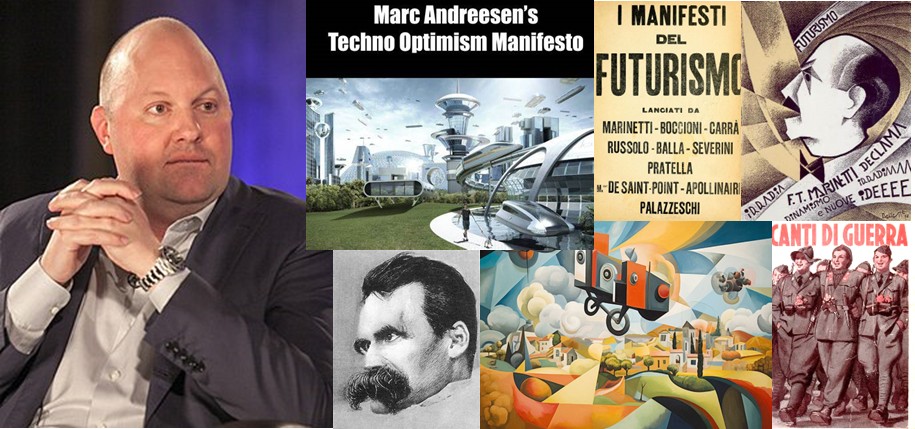
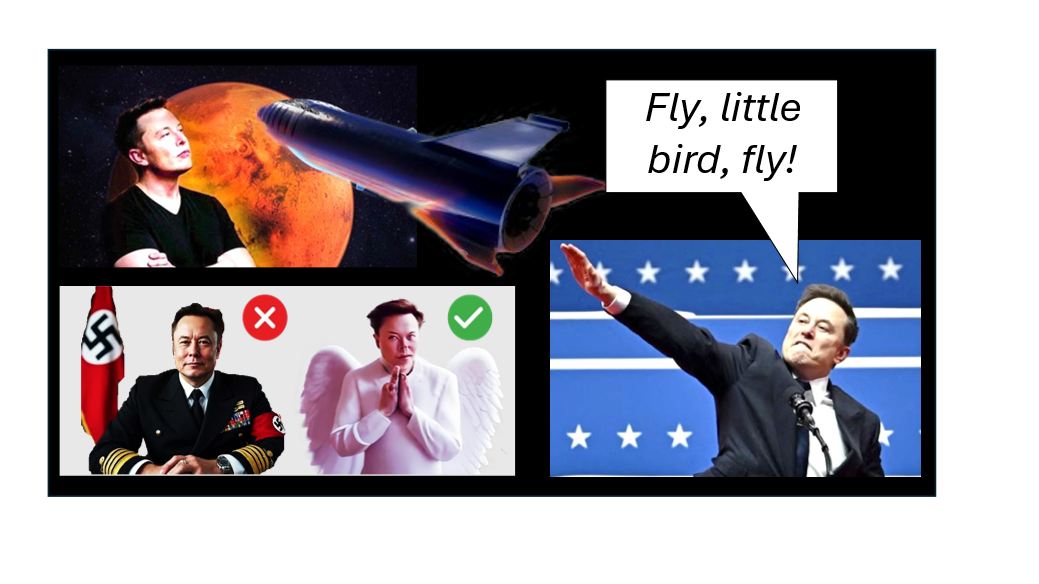
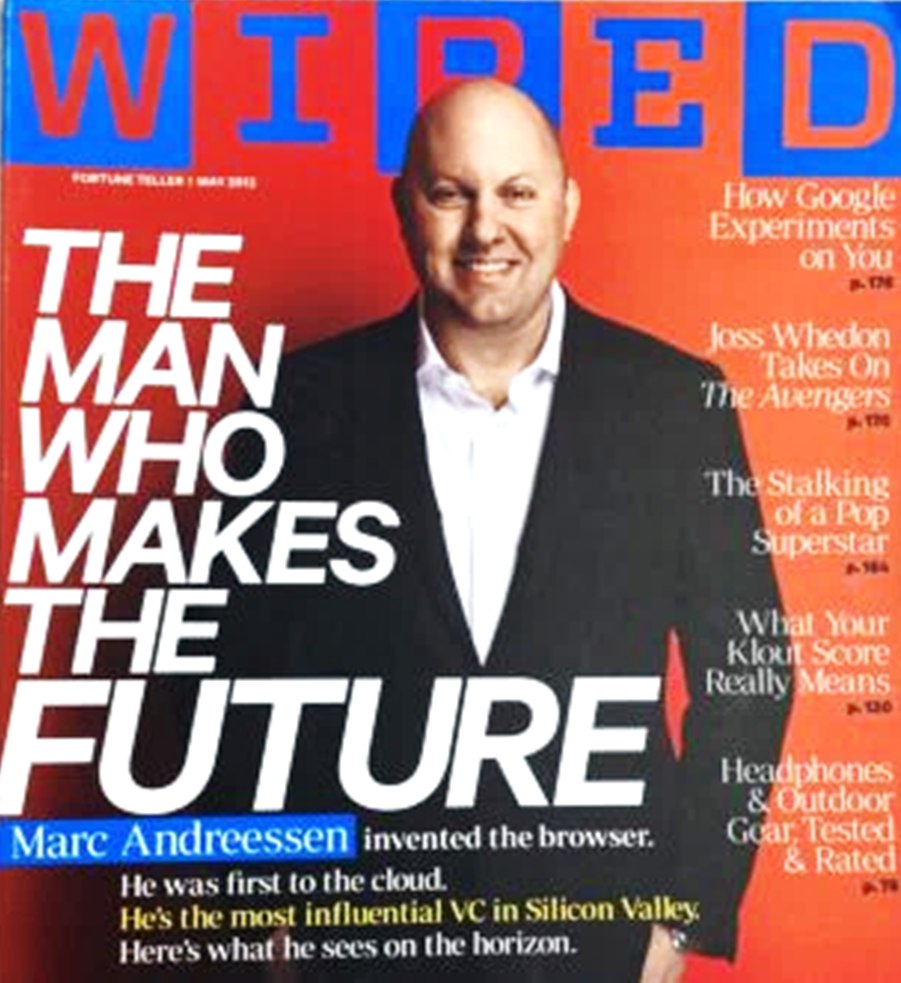
All tech billionaires are visionaries and have visions and dreams, like Elon Musk with his trip to Mars, but Marc Andreessen has more than that. He has both a creed and a mission manifesto, The Techno-Optimism Manifesto.
The manifesto can be found on the website of Andreessen Horowitz, one of the world's largest venture capital firms with over 45 billion dollars under management, also commonly known - remember we are in the world of nerds - under the name a16z. Crack the code yourself.
The manifesto is very long, 4939 words. It is also very elegantly written as one-liners bursting with lessons and quotes from the history of philosophy and the great thinkers of liberal economics, and with a logical rhythm and mesmerizing power of persuasion that draws the reader in.
You are obviously up against a lot of IQ points, and only a contrarian person who has little knowledge himself will be able to resist the suction. A confirmation student doesn't stand a chance.
If you don't trust my summary, which, although it will necessarily be long with the quotes, must of course be greatly shortened; or if you think it is biased, you can read the entire manifesto for yourself here
https://a16z.com/the-techno-optimist-manifesto
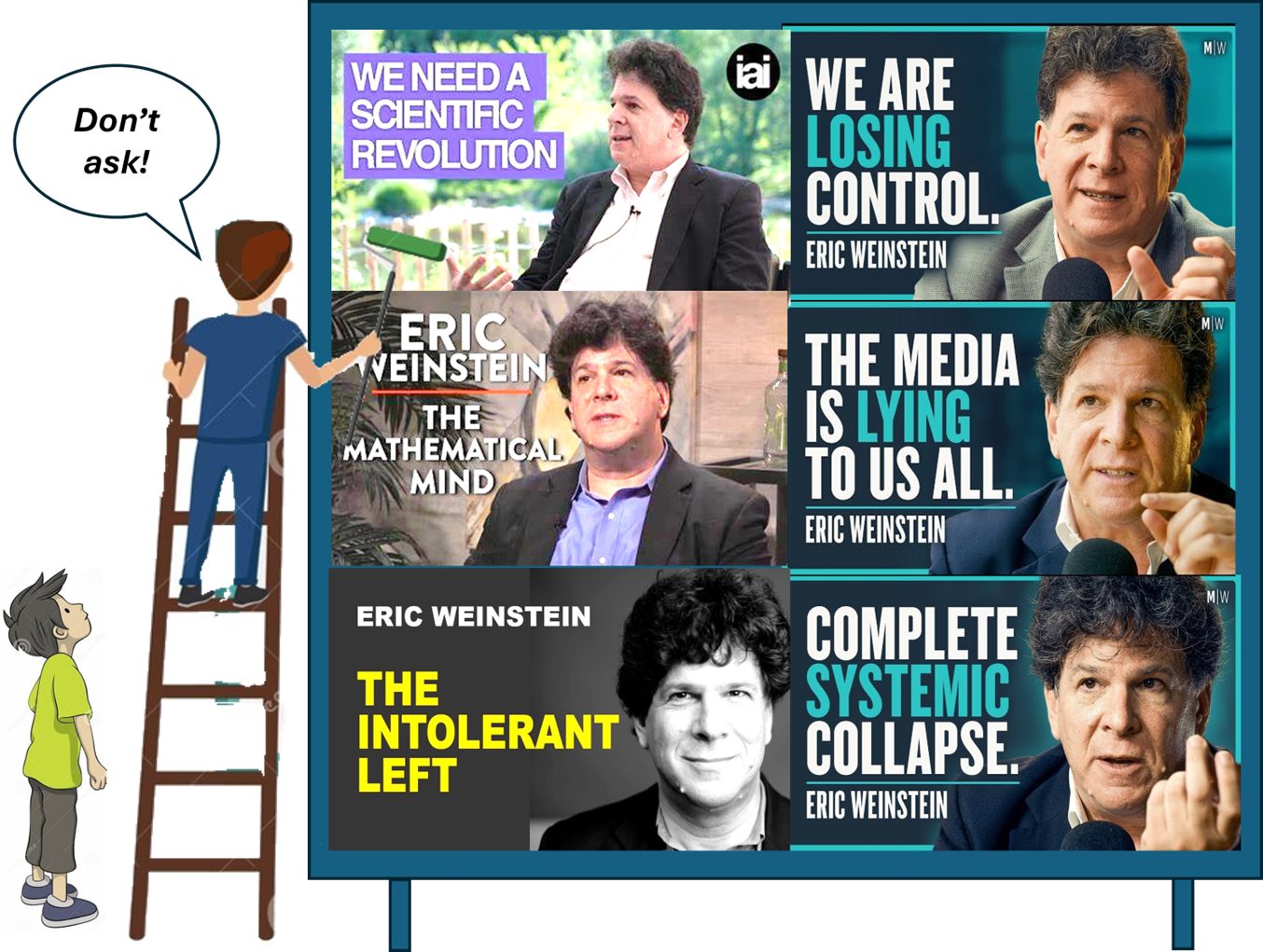
Like Ayn Rand, Curtis Yarvin and Eric Weinstein, Andreessen starts from the first line of his manifesto by lamenting the decline of the times.
“We are lied to.
We are told that technology is taking our jobs, reducing our wages, increasing inequality, threatening our health, destroying the environment, degrading our society, corrupting our children, weakening our humanity, threatening our future, and is always on the verge of destroying everything.
We are told to be angry, bitter, and resentful of technology.
We are told to be pessimistic.
The myth of Prometheus—in various updated forms like Frankenstein, Oppenheimer, and Terminator—haunts our nightmares.
We are told to reject our birthright—our intelligence, our control over nature, our ability to build a better world.
We are told to be miserable about the future.”
Andreessen also tells us, but only at the end, who the enemy is who is lying and robbing us of our natural optimism.
“We have enemies.
Our enemies are not bad people – but rather bad ideas.
Our current society has been subjected to a massive demoralization campaign for six decades – against technology and against life – under various names such as ‘existential risk’, ‘sustainability’, ‘ESG’, ‘Global Goals’, ‘social responsibility’, ‘stakeholder capitalism’, ‘the precautionary principle’, ‘trust and security’, ‘tech ethics’, ‘risk management’, ‘de-growth’, ‘limits to growth’.
This demoralization campaign is based on bad ideas from the past – zombie ideas, many derived from communism, disastrous then and now – that have refused to die.
Our enemy is stagnation.
Our enemy is anti-merit, anti-ambition, anti-striving, anti-achievement, anti-greatness.”
A long list of enemies is then listed, until Andreessen pinpoints the real enemy of progress, Friedrich Nietzsche’s Last Man, who avoids all risk, passion, ambition and self-realization in favor of security and comfort. In the manifesto, Andreessen copies a long passage from Nietzsche’s Thus Spoke Zarathustra, from which we snatch a small piece:
“Alas! The time will come when man will no longer give birth to a star. Alas! The time will come for the most despicable man, who can no longer despise himself...
‘What is love? What is creation? What is longing? What is a star? - asks the last man and blinks.
The earth has become small, and on it the last man jumps, who does everything small. His species is indelible like the flea; the last man alive the longest...”
“Our enemy is…THAT,” Andreessen writes emphatically. “We strive to be…Not THAT.”
The alternative to Nietzsche's Last Man is of course Nietzsche's Übermensch, who is able to overcome himself and through his willpower, intelligence and creativity can create his own meaning and his own values. The one, but strong, manages to live in freedom from the crowd and the embrace, demands and conventions of the social environment.
This is how signature nerds from childhood, for understandable reasons, want to see themselves. Misunderstood loners, held down by and victims of a bunch of less intelligent bullies.
Was Nietzsche Asperger's? We know that he was very gifted, was accepted early into an elite school, and became a professor at the university at the age of 24. We also know that he was socially impossible, isolated himself and was lonely and unhappy, overfocused intensely on specific subjects, and also had other symptoms compatible with autism syndrome. The researchers have therefore not ruled out the possibility, although the favorite explanation is probably syphilis and insanity. But they do not of course rule out each other.,
It cannot therefore be ruled out that Friedrich would have been spared much suffering if he had had a Commodore64 as a child.
But the world would also have missed a God-given writer who shook and turned the world with his shocking declaration that God was dead, and thus secured employment for thousands of university literati and philosophers.
It is therefore hardly a coincidence that Nietzsche is given such a prominent place in Andreessen's manifesto. Nor is it a coincidence that Andreessen in his manifesto designates the signature nerd's foremost characteristic, intelligence, as the driving force of the world. He writes:
"We believe that intelligence is the ultimate driving force for progress. Intelligence makes everything better. Intelligent people and intelligent societies outperform less intelligent ones on virtually every parameter that we can measure. Intelligence is humanity's birthright; we should expand it as completely and spread it as far as we possibly can."
And if human intelligence is good, artificial intelligence and artificial superintelligence are possibly even better (read for yourself), and if they can be combined, nothing is impossible. Andreessen writes:
“We believe that intelligence is in an upward spiral – first, as more smart people around the world are recruited into the technocapital machine; second, as humans form symbiotic relationships with machines for new cybernetic systems such as corporations and networks; third, as artificial intelligence increases the capabilities of our machines and ourselves. We believe that we are ready for an intelligence take-off that will expand our capabilities to unimaginable heights.”
The technocapital machine that Andreessen mentions here is the union of 1. intelligence, 2. technology, and 3. the free market, which he sees as the primary source of growth and thus the foundation for the development of civilization, a development that is limitless if not hindered by zombies and “the eternal howling of communists and Luddites.”
This is where Andreessen’s technooptimism comes into full play, but it is mostly familiar and banal neoliberal stuff. Far more interesting is the credo he includes in the manifesto:
“We believe in the love story of technology and the romance of industry. The eros that is in the car, the electric light and the skyscraper. In the microchip, the neural network, the rocket, the split atom.
We believe in adventure. To set out on the Hero’s Journey, to rebel against the status quo, to chart uncharted territory, to defeat dragons and bring the spoils home to our society. To paraphrase a manifesto from another time and place: ‘Beauty exists only in struggle. There is no masterpiece that does not have an aggressive character. Technology must be a violent attack on the forces of the unknown, to force them to bow to man.’”
The manifesto “from another time and place,” which anticipates Eric Weinstein’s thoughts from the last chapter about a necessary connection between creativity and aggression, about technological innovation as violence, was written by the Italian poet Filippo Tommaso Marinettei and first published in 1909 in the French newspaper Le Figaro.
It became the basis for Futurism, a revolutionary artistic and literary movement of the early twentieth century that celebrated the future, technology, the beauty of the speed of machines, masculinity and strength, and the modern lifestyle, and rejected outdated classical culture.
“Art can in fact be nothing but violence, cruelty, and injustice,” Marinetti declared, glorifying violence and war as a form of “purification” and a necessity for creating a new and modern world. The Futurist Manifesto described war as “the only purifier of the world,” and violence was seen as a way to break with the traditions of the past and make room for the innovation of the future.
Marinetti, who himself became a fascist, and other Futurists supported Mussolini’s fascism as a shortcut to their vision of a modern and dynamic Italy. And with its aesthetics and ideology integrated into fascist art and architecture, Futurism became part of the cultural propaganda that supported fascism.
It is thus interesting to see how the ends meet in Marc Andreessen's manifesto.
Although he looks like a futurist, Marc Andreessen is of course no Mussolini fascist. But perhaps in his Techno-Optimistic Manifesto we see the birth of a whole new species for our fascist zoo: Technofascism.